Electronic Structure Calculations
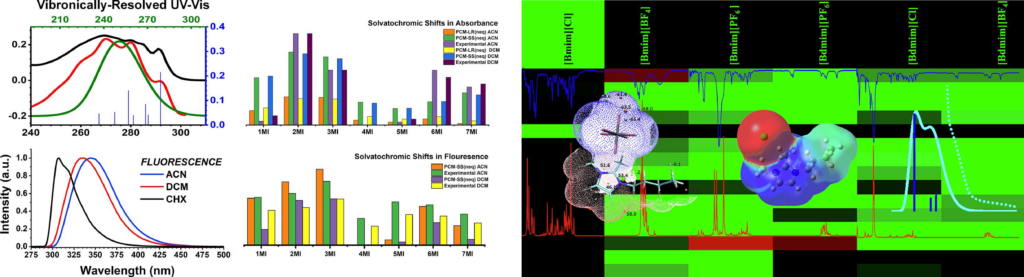
Electronic structure calculations are vital tools in the analysis and understanding of molecular properties such as structure, spectroscopic features, and interaction profiles. Theoretical determination of structural and spectroscopic properties through electronic structure calculations fulfills the need for a visual representation of the characteristics and estimates some behavior before performing experiments.
We focus on calculations that capture the experimental observations most accurately. We compute structural and spectroscopic properties such as vibrational spectra, molecular orbitals, and nonlinear optical properties, and perform population analysis using Density Functional Theory (DFT) based theories. Using different types of wave function analysis techniques, we explore the underlying reasons behind experimental observations.
Recently, our main focus in calculations has been the determination of electronic structure properties for imidazolium-based ionic liquids (IILs) and their dependence on cation-anion shape and size. Ionic Liquids (ILs) are unique in many perspectives such as being designer solvents, green chemistry solutions for the future, and electrochemical media with high thermal stability. Their structure is also unique comparing common solvents that are held by weak interactions and the Coulombic interactions that exist in ILs. IILs with long alkyl chains are known for the formation of a nanostructural organization that occurs as the isolation of ionic groups from non-polar alkyl tails in different domains. This nanostructural character of ILs has been observed in experiments and molecular dynamic (MD) simulations. We want to find any connections between this unique nanostructural property of IILs and their electronic structures and answer whether the main reason is the intermolecular forces by themselves or any intrinsic nature results in this way.
We also study the electronic structure calculations of transition metal complexes of biologically active ligands that are used for pharmaceutical interest. Calculation and modeling of these complex structures are important because the compounds are obtained often time in a noncrystalline form so that the geometrical structure cannot be determined experimentally. Using the techniques of elemental analysis, vibrational spectroscopy, NMR, and some other techniques available to us, we determine the chemical composition and binding information. Based on our experimental analysis, we model the structure and reproduce experimental observations theoretically making possible well-defined molecular geometry and properties more precisely.